



How Aerospace Ultrasonic Cleaners Improve Precision Part Cleaning
Written by: Michael Danese | April 9, 2026
 Aerospace components fail when contamination isn’t completely removed, not because of visible debris, but because of sub-micron particles and residues buried in blind holes, internal channels, and threaded surfaces that traditional cleaning methods cannot reach.
Oils, machining residues, and microscopic particulates compromise coating adhesion, disrupt hydraulic flow, and accelerate wear on components that operate under extreme mechanical stress.
Meeting OEM cleanliness specifications — typically governed by standards such as SAE AS4059 for aerospace hydraulic fluid cleanliness, or internal OEM acceptance criteria for structural and precision components — requires a cleaning process that is consistent, geometry-agnostic, and chemically minimal.
Aerospace ultrasonic cleaners using optimized frequencies and Kaijo’s Water Resonance System (WRS), which increases cavitation effect by over 500%, deliver the depth, uniformity, and repeatability that precision aerospace manufacturing demands.
Table of Contents
- The Critical Role of Precision Cleaning in Aerospace Manufacturing
- How Ultrasonic Cleaning Technology Works
- Optimizing Cleaning Performance with Ultrasonic Frequency Selection
- Enhancing Ultrasonic Cleaning with Kaijo’s Water Resonance System (WRS)
- Achieving Reliable Cleaning Across Aerospace Materials
- Why Aerospace Manufacturers Choose Kaijo Ultrasonic Cleaning Solutions
- Frequently Asked Questions
1. The Critical Role of Precision Cleaning in Aerospace Manufacturing
Aerospace components operate within systems where OEM cleanliness specifications are non-negotiable. A single contaminated hydraulic fitting, fuel component, or turbine blade can trigger cascading failures with serious operational consequences. Compliance with OEM cleanliness specifications is required across both production and MRO environments, and cleaning processes must demonstrate consistent, verifiable results across every production batch.
Components requiring precision cleaning include:
| Component | Why Cleaning Is Critical |
| Turbine components | Removal of carbon deposits and combustion residues that degrade thermal performance |
| Fuel system components | Contamination disrupts flow calibration and injector precision |
| Hydraulic system parts | Particulates cause valve stiction, seal damage, and system malfunction |
| Landing gear components | Structural and actuator parts must meet OEM specifications before returning to service |
| Aerospace fasteners | Threaded surfaces trap machining oils and particulates that compromise torque values |
| Precision-machined components | Tight tolerance features require contaminant removal without dimensional change |
The cost of contamination is direct and measurable:
- Performance degradation and reduced operational lifespan
- Premature component failure from particulate-driven wear
- Expensive rework, inspection failures, and production downtime
- Rejected batches and OEM compliance failures
Industrial ultrasonic cleaners deliver uniform cleaning energy throughout the bath, enabling the removal of contaminants from complex internal surfaces that spray-wash and manual methods cannot access.
2. How Ultrasonic Cleaning Technology Works
Ultrasonic cleaning reaches surfaces that no manual or spray-wash method can access — including blind holes, internal channels, and fine machined features — through a precisely controlled physical process: acoustic cavitation.
The Cavitation Process
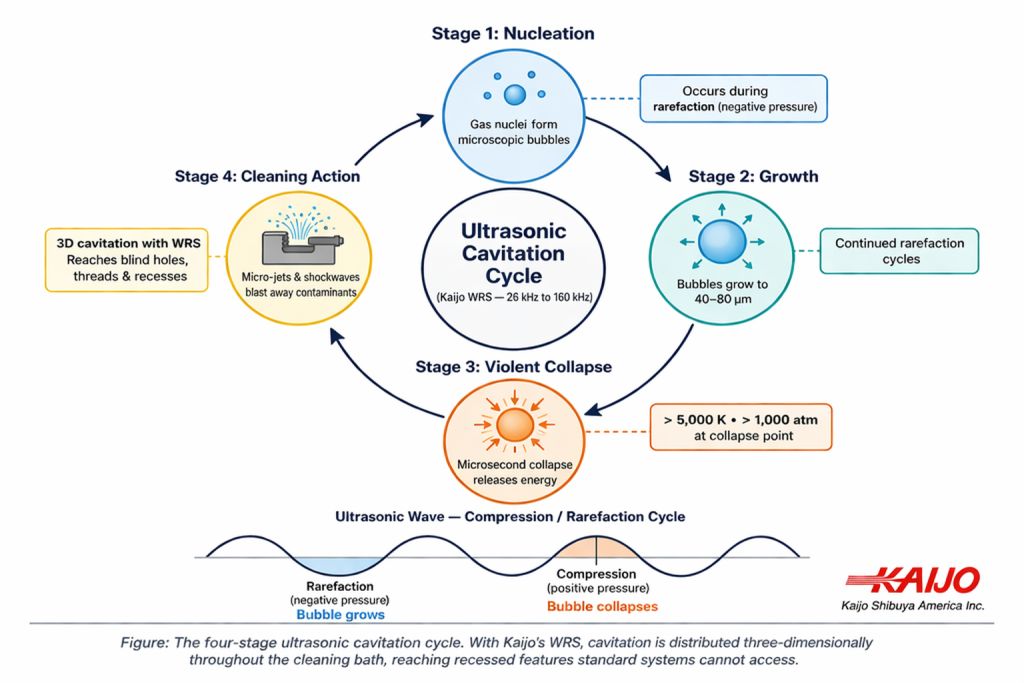
Ultrasonic transducers convert electrical energy into high-frequency sound waves in the cleaning fluid. These waves create alternating compression and rarefaction cycles, generating millions of microscopic vacuum bubbles. During the compression cycle, those bubbles implode violently, releasing enormous localized energy.
- Ultrasonic wave generation — Transducers generate high-frequency sound waves across the ultrasonic range (26 kHz to 160 kHz), depending on the application requirement
- Bubble formation — Low-pressure rarefaction cycles create microscopic bubbles that implode during the subsequent compression cycle
- Contaminant removal — Millions of imploding bubbles produce pressure waves that penetrate deep into complex geometries, dislodging contaminants from every accessible surface
Why Cavitation Works for Complex Geometries
Cavitation bubbles collapse at temperatures of approximately 5,000 K and with extreme localized pressures — yet are so microscopic they do no more than clean and remove surface contaminants from properly configured components. This means aggressive cleaning is delivered at the microscopic level without risking surface damage when the correct frequency is selected.
Higher frequencies produce smaller cavitation bubbles with finer cavitation distribution, enabling cleaning of more intricate surface detail. A high-frequency ultrasonic cleaner can reach:
- Blind holes and internal channels
- Fine surface features and threaded connections
- Complex machined contours
- Narrow grooves and recesses inaccessible to manual methods
3. Optimizing Cleaning Performance with Ultrasonic Frequency Selection
Selecting the correct ultrasonic frequency directly determines cleaning effectiveness for a given aerospace application. Frequency controls cavitation bubble size, cleaning intensity, and the ability to reach intricate component features.
Kaijo supports four frequency ranges for aerospace applications — ultrasonic, high-frequency ultrasonic, midsonic, and megasonic — allowing engineers to precisely match cleaning energy to the material and the type of contamination.
Frequency Selection Quick Reference for Aerospace Applications
| Frequency Range | Classification | Best For | Typical Aerospace Applications |
| 26–38 kHz | Ultrasonic | Hard metals (steel, titanium, brass) | Engine components, carbon deposit removal, heavy machining residue |
| 78–160 kHz | High frequency ultrasonic | Softer metals, precision parts | Hydraulic parts, fasteners, precision-machined components |
| 200–750 kHz | Midsonic | Delicate substrates, sensitive components | FPD glass for cockpit and avionics displays, sensitive sensors |
| 950 kHz–2 MHz | Megasonic | Highly sensitive components | Avionics, optical elements, electronics assemblies |
Kaijo’s aerospace ultrasonic cleaners operate from 26 kHz to 160 kHz in the ultrasonic range, midsonic systems operate from 200 kHz to 750 kHz and megasonic systems operate from 950 kHz to 2 MHz.
- Lower frequency (26–38 kHz): Produces stronger cavitation for hard materials — steel, titanium, brass — requiring removal of heavy contamination such as grease or thick carbon deposits
- Higher ultrasonic frequency (78–160 kHz): Ideal for softer metals and fine particulate removal — hydraulic parts, precision instruments, and detailed machined features
- Midsonic (200–750 kHz): Produces very fine, low-energy cavitation suited to fragile substrates that cannot tolerate aggressive cleaning. Used in aerospace manufacturing for FPD glass — the glass substrates used in cockpit and avionics flat panel displays — and for cleaning sensitive sensors where conventional ultrasonic frequencies risk surface or coating damage
- Megasonic (950 kHz–2 MHz): For highly sensitive components — avionics and precision electronic assemblies — delivering sub-micron particle removal without surface damage
Optimized frequency selection delivers:
- Improved contaminant removal matched to specific material and contamination type
- Reduced risk of surface damage on delicate aerospace alloys
- Consistent cleaning performance across production batches
- Shorter cleaning cycles and improved throughput
4. Enhancing Ultrasonic Cleaning with Kaijo’s Water Resonance System (WRS)
Kaijo’s Water Resonance System (WRS) — recipient of the Acoustical Society of Japan Engineering & Development Award (2007) — is a proprietary water treatment technology that conditions the cleaning bath to produce smaller, more uniform cavitation bubbles distributed evenly throughout the tank.
How WRS Technology Works
The WRS is available in inline and once-through models, treating the water supply to improve cavitation bubble formation by managing dissolved gases and optimizing the nuclei that initiate cavitation.
- Dissolved Gas Management — Dissolved gases produce inactive bubbles that block effective cavitation. By removing these, WRS ensures that ultrasonic energy produces active cleaning cavitation throughout the entire bath
- Enhanced Nuclei Distribution — Optimized nuclei promote an even distribution of active cavitation bubbles across the tank, eliminating dead zones where cleaning effectiveness is otherwise reduced
- 3-Dimensional Cavitation — WRS generates true 3-dimensional cavitation throughout the cleaning tank, reaching internal surfaces and complex passages that standard ultrasonic waves cannot completely access
Measured Sound Pressure Improvement with WRS
Kaijo’s internal testing directly measures the impact of WRS on sound pressure distribution across the cleaning bath. The 3D sound pressure map below compares bath performance with and without WRS at identical ultrasonic power settings.
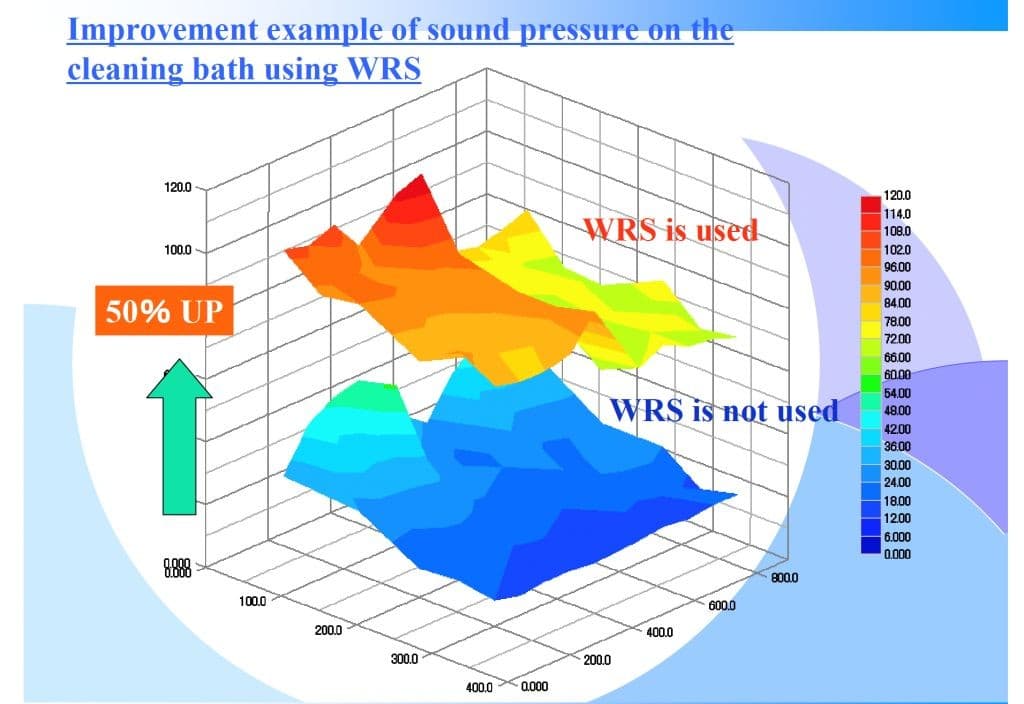
The data shows a clear and significant difference across the entire tank surface:
- Without WRS: Sound pressure levels range from near zero to approximately 60–66 units, with pronounced low-pressure dead zones concentrated away from the transducer
- With WRS: Sound pressure levels rise across the entire bath surface, reaching peaks of 114–120 units, uniformly distributed across all measured positions
The result: a measured 50% increase in sound pressure throughout the cleaning bath — meaning every point in the tank delivers meaningfully stronger cavitation, not just the area directly above the transducer.
Full WRS Performance Data
| Performance Metric | WRS Result |
| Sound pressure across the bath | 50% increase (measured across the full tank surface) |
| Peak sound pressure | Up to 114–120 units vs. 60–66 without WRS |
| Overall sound pressure output | 5x greater than conventional systems |
| Cavitation effect | Over 500% increase |
| Transducer and product lifetime | Extended 3–10x |
| Chemical dependency | Reduced or eliminated |
| Operational noise | Reduced |
Ideal Applications for WRS Technology
The WRS delivers the greatest benefit for aerospace components with:
- Intricate internal geometries and deep channels where transducer-proximal cleaning is insufficient
- Cylinders and enclosed cavities where standard ultrasonic waves cannot completely reach
- Complex machined features and blind holes requiring consistent cavitation at every surface
By combining optimized ultrasonic frequencies with Kaijo’s WRS, manufacturers achieve consistent, efficient cleaning outcomes — while reducing or eliminating dependence on aggressive cleaning chemicals.
5. Achieving Reliable Cleaning Across Aerospace Materials
Aerospace ultrasonic cleaning systems must safely clean the diverse materials used across aircraft and spacecraft manufacturing — each with different hardness, geometry complexity, and contamination profiles.
Common Aerospace Materials and Recommended Frequency Ranges
| Material | Properties | Typical Components | Recommended Frequency |
| Aluminum alloys | Lightweight, moderate hardness | Structural components, housings | 78–160 kHz |
| Titanium | High strength-to-weight ratio | Engine parts, landing gear, fasteners | 26–40 kHz |
| Stainless steel | Corrosion-resistant | Hydraulic fittings, structural parts | 26–40 kHz |
| Nickel-based superalloys (Inconel) | High-temperature performance | Turbine blades, combustion components | 26–38 kHz |
| Precision-machined alloys | Tight tolerances, complex features | Fuel system components, actuators | 78–160 kHz |
| FPD glass substrates | Fragile, surface-sensitive | Cockpit and avionics flat panel displays | 200–750 kHz (midsonic) |
| Sensitive sensors | Delicate coatings and fine surface features | Aerospace sensors and instrumentation | 200–750 kHz (midsonic) |
Kaijo’s systems are configured to clean aluminum, titanium, stainless steel, Inconel, FPD glass, and sensitive sensor assemblies without surface damage or dimensional change.
Contaminant types addressed:
- Machining oils and coolants
- Metallic particulates and debris
- Carbon deposits and combustion residues
- Polishing compounds and assembly lubricants
- Oxidation and coating residues
Kaijo’s systems allow engineers to configure cleaning parameters based on material hardness, component geometry, contamination type, required cleanliness level per OEM specification, and production throughput requirements.
6. Why Aerospace Manufacturers Choose Kaijo Ultrasonic Cleaning Solutions
Aerospace production and MRO operations require cleaning processes configured to OEM cleanliness specifications and capable of performing reliably on high-value components across every batch. Kaijo’s systems are configured to specific part geometries, material types, and contamination profiles — reducing chemical dependency while delivering shorter cleaning cycles and batch-consistent results.
Precision-Engineered Technology
| Capability | Detail |
| Ultrasonic frequency range | 26 kHz to 160 kHz |
| Midsonic frequency range | 200 kHz to 750 kHz — FPD glass and sensitive sensor cleaning |
| Megasonic frequency range | 950 kHz to 2 MHz |
| Water Resonance System | Over 500% increase in cavitation effect with 3-dimensional cavitation |
| Sound pressure improvement | 5x greater output with 50% increase in measured bath pressure |
| Transducer & product lifetime | Extended 3–10x with WRS |
| OEM cleanliness compliance | Configured to OEM cleanliness specifications |
| Chemical reduction | Reduced or eliminated with WRS |
Benefits for Production and MRO Operations
- Improved cleaning consistency across every production batch — including surfaces previously in dead zones
- Reduced process variability and lower rework rates
- Enhanced production efficiency and shorter cycle times
- Improved component quality and reliability at return to service
- Reduced chemical usage and lower operational costs
Kaijo has been a global leader in ultrasonic cleaning technology for over 70 years, serving diverse manufacturing industries with industrial ultrasonic cleaning systems that maximize cleaning efficiency while supporting environmental sustainability.
Key Takeaways
- Precision cleaning is non-negotiable in aerospace manufacturing — sub-micron contamination on turbine parts, hydraulic components, and precision assemblies triggers failures, rework, and OEM compliance failures
- Acoustic cavitation reaches surfaces that no other method can — blind holes, internal channels, and complex machined features are fully addressable with correctly configured ultrasonic systems
- Kaijo supports four frequency ranges — 26–38 kHz ultrasonic, 78–160 kHz high-frequency ultrasonic, 200–750 kHz midsonic, and 950 kHz–2 MHz megasonic — covering everything from heavy engine component cleaning to FPD glass and sensitive sensor cleaning
- Kaijo’s WRS delivers a measured 50% increase in sound pressure across the full bath surface, eliminating dead zones — plus over 500% increase in cavitation effect and 5x greater sound pressure output
- Transducer and product lifetime is extended 3–10x with WRS, directly reducing maintenance costs and unplanned downtime
- Systems are configured to OEM cleanliness specifications, supporting aluminum, titanium, stainless steel, and nickel-based superalloys without surface damage
Ready to Optimize Your Aerospace Cleaning Process?
Aerospace MRO operations and production facilities that need consistent, OEM-specified cleaning results for turbine components, hydraulic parts, and precision aerospace assemblies can rely on Kaijo’s frequency-optimized ultrasonic cleaning systems with Water Resonance System technology.
Explore Kaijo’s aerospace cleaning solutions to review system specifications and application data, or contact us for a free consultation to discuss your specific component geometries, materials, and cleanliness requirements.
7. Frequently Asked Questions
Q1. What are aerospace ultrasonic cleaners used for?
Aerospace ultrasonic cleaners remove oils, particulates, and machining residues from precision aerospace components while maintaining the strict cleanliness standards required by OEM specifications across production and MRO environments.
Q2. Why is ultrasonic frequency important in aerospace cleaning?
Frequency determines the size of cavitation bubbles and the cleaning intensity. Kaijo supports four ranges: lower frequencies (26–38 kHz) provide aggressive cleaning for heavy contamination on hard metals; higher ultrasonic frequencies (78–160 kHz) suit softer metals and precision parts; midsonic frequencies (200–750 kHz) are used for fragile substrates such as FPD glass and sensitive sensors; and megasonic frequencies (950 kHz–2 MHz) deliver sub-micron particle removal for the most sensitive aerospace components.
Q3. What types of aerospace components benefit from ultrasonic cleaning?
Turbine parts, fuel system components, hydraulic parts, aerospace fasteners, landing gear components, FPD glass substrates used in cockpit and avionics displays, sensitive sensors, and precision machined assemblies with complex geometries that traditional cleaning methods cannot adequately reach.
Q4. What is Kaijo’s Water Resonance System (WRS)?
The WRS is Kaijo’s proprietary, award-winning water treatment technology. It conditions the cleaning bath by managing dissolved gases and optimizing cavitation bubble formation. Kaijo’s measured data shows a 50% increase in sound pressure across the full bath surface when WRS is used, with peak levels reaching 114–120 units compared to 60–66 without WRS. Overall, WRS delivers over 500% increase in cavitation effect, 5x greater sound pressure output, and 3-dimensional cavitation throughout the tank.
Q5. How does the WRS reduce chemical usage in aerospace cleaning?
By significantly increasing cavitation effect and uniformity throughout the tank, the WRS enables thorough cleaning with water alone or with minimal detergent. This reduces or eliminates the need for aggressive chemical baths, lowering procurement, handling, and disposal costs while improving workplace safety.
Q6. How does Kaijo configure an ultrasonic cleaning system for a specific aerospace application?
Kaijo works directly with production and process engineering teams to assess component geometry, material type, contamination profile, and required cleanliness level, then configures the system frequency, power, and WRS specification accordingly.
Q7. How long does it take to implement a Kaijo ultrasonic cleaning system in an existing production line?
Implementation timeline depends on system configuration, facility requirements, and integration complexity. Kaijo works directly with production and process engineering teams through the design and installation process — from application assessment through system commissioning — to minimize disruption to existing workflows.