

Kaijo to Showcase Advanced Megasonic, Water Resonance, and Single Wafer Cleaning Technologies at Semicon West 2026
Written by: Michael Danese | September 25, 2026
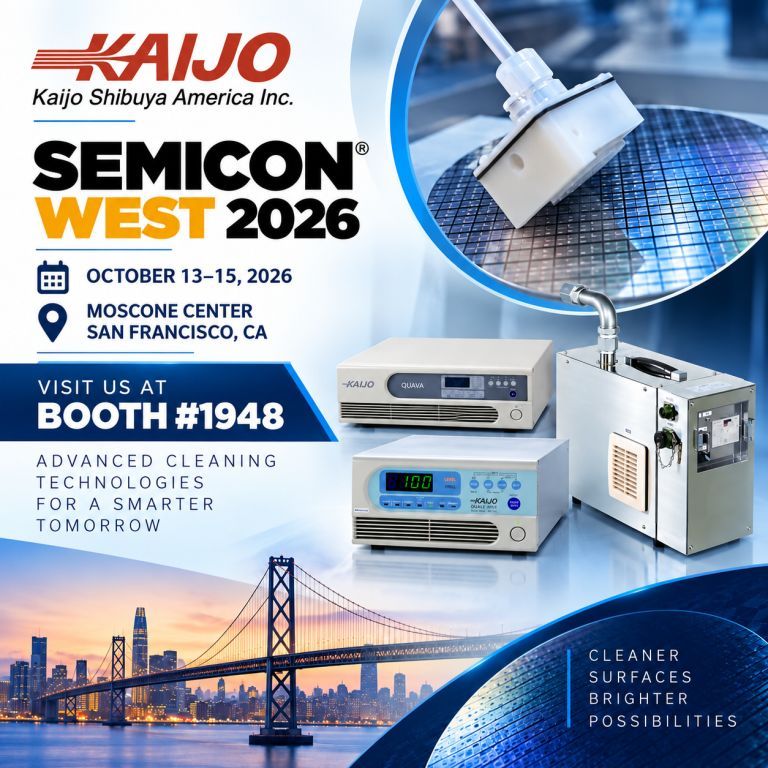
Kaijo Shibuya America will exhibit at Semicon West 2026 in Booth #1948, and this article explains the megasonic cleaning systems, Water Resonance System, and single-wafer cleaning technologies on display, along with the process problems each addresses.
Table of Contents
- Kaijo at Semicon West 2026: Booth #1948 Event Details
- Megasonic Cleaning Systems for Delicate Substrates
- Water Resonance System: Uniform Cavitation in Large Ultrasonic Cleaning Tanks
- Single Wafer Cleaning Systems: Consistent Results Wafer After Wafer
- Comparing the Three Wafer Cleaning System Technologies
- Industrial Ultrasonic Cleaners: Applications Across Industries
- Matching the Right Cleaning System to Your Process
- Frequently Asked Questions
Kaijo at Semicon West 2026: Booth #1948 Event Details
Semicon West brings semiconductor manufacturers, equipment suppliers, and process engineers together to look at what is changing across the semiconductor processing supply chain. This year, Kaijo Shibuya America will use the show to present cleaning technologies developed for wafer and substrate cleaning, where particle removal and repeatability matter most.
Event Details
For process and manufacturing teams, the show is a practical opportunity to evaluate cleaning equipment in person, compare approaches side by side, and ask detailed questions about specific substrates and contaminants.
- Dates:October 13–15, 2026
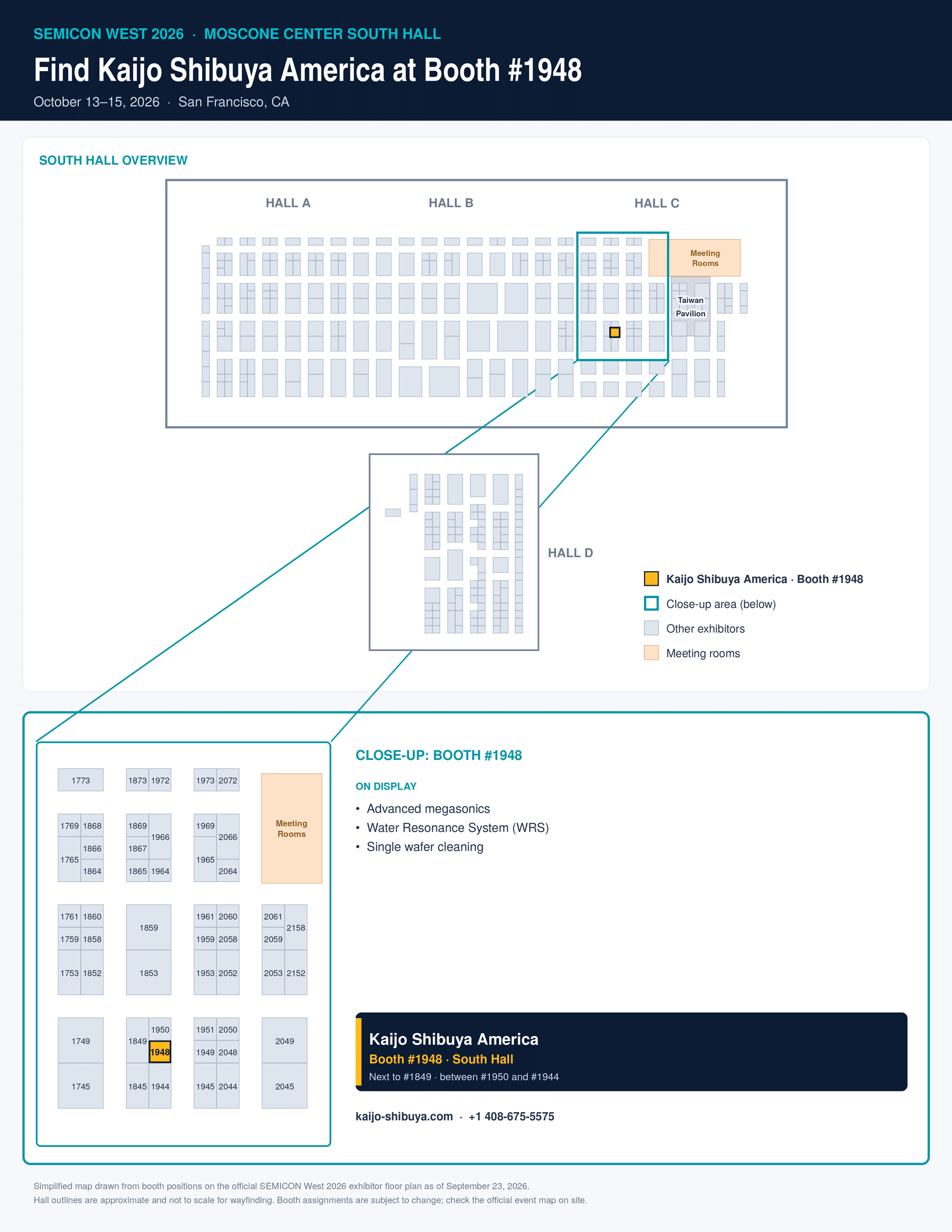
- Location:South Hall, Moscone Center, San Francisco, CA
- Booth:#1948
- On display:Advanced megasonics, the Water Resonance System (WRS), and single wafer cleaning technologies
Kaijo builds systems for semiconductor manufacturing, electronics, automotive, aerospace, and medical device production. Each system is sized and tuned to the substrate, the contaminant, and the throughput a customer needs, with attention to chemical use and energy draw. For engineers under pressure to raise yield without adding cycle time, the booth offers a chance to discuss specific cleaning problems with the people who configure these systems.
Megasonic Cleaning Systems for Delicate Substrates
Megasonic cleaning uses frequencies far above conventional ultrasonic cleaning to remove very small particles from sensitive surfaces (see megasonic cleaning for background). Parts that contain soft materials may require cleaning with the less energetic cavitation bubbles produced at higher frequencies, which is why megasonic systems are used on wafers, masks, and other delicate substrates.
Kaijo’s Quava megasonic generators are part of its family of megasonic cleaning systems and deliver high-power, precision particle removal with frequency, waveform, and power settings matched to the application.
Quava Megasonic Cleaning System Capabilities
- 1,200 watts maximum per generator, at 430 kHz, 750 kHz, and 950 kHz, giving enough power to remove sub-micron particles while you choose the frequency that protects the substrate
- One generator supports 10 frequencies from 26 kHz to 950 kHzso that a single platform can cover multiple process steps
- Automatic frequency tracking with PLL, Sweep and Pulse modes, which helps keep cleaning output stable from run to run
- Programmable soft start and soft stop, reducing abrupt energy changes on delicate parts
- Compatible with all Kaijo transducer arrays, simplifying integration with existing tanks and tools
- Removable matching box for frequency adaptation, making it practical to change frequencies as process requirements evolve
Where Quava Megasonics Fit
Kaijo designs the Quava megasonic cleaning system for semiconductors, flat panel displays, hard disk components, and solar components. In each case, the requirement is the same: remove sub-micron particles without damaging the surface. Selecting frequency and oscillation mode for the specific substrate is what makes that balance achievable. Learn more on the Quava Megasonic Cleaning System page.
“Our megasonic cleaners feature unique operation modes to handle delicate substrate cleaning,” said Michael Danese, President of Kaijo Shibuya America Inc.
Water Resonance System: Uniform Cavitation in Large Ultrasonic Cleaning Tanks
In larger tanks, uneven cavitation creates weak zones where parts aren’t fully cleaned. Parts that contain sound-absorbing materials can make this worse. Kaijo’s Water Resonance System is ultrasonic industrial cleaning equipment that works with any industrial ultrasonic cleaner and addresses the problem in the water itself.
The WRS conditions the cleaning bath by removing dissolved gas and optimizing the nuclei that form cavitation bubbles. Those nuclei promote an even distribution of cavitation bubbles throughout the tank. The result is up to 500% more cavitation energy and 5× greater sound pressure compared with industrial ultrasonic cleaners that do not use WRS.
What the WRS Offers Your Process
- Uniform cleaning across the full tank volume, providing true three-dimensional cleaning and reducing rework from uneven zones
- Reach inside complex geometries and cylinderswhere standard ultrasonic waves cannot completely reach
- Two configurations:an inline model for recirculating baths and a once-through (WRS-F) model inserted in the water supply, so it fits existing line layouts
- Proven on demanding parts, including machined and post-heat-treated parts, wires, ceramic components, HDD components, and metal and glass parts
- Quieter, longer-lasting operation:Kaijo reports less operational noise than standard systems and a 3–10× longer product lifetime than conventional models, with transducers heat-resistant to 60°C
The WRS is especially relevant for large ultrasonic cleaners, where maintaining consistent cavitation from corner to corner is difficult. For more detail, read why Kaijo’s WRS is needed in some ultrasonic cleaning applications.
Single Wafer Cleaning Systems: Consistent Results Wafer After Wafer
Batch and cassette tanks share chemistry across many wafers, which introduces cross-contamination risk. Single wafer, close-proximity megasonic cleaning applies megasonic energy directly to the target object, one piece at a time. The goal is consistent, piece-to-piece cleaning results.
Kaijo’s single wafer product set includes the Quava Spot Shower line, Quava Mega Puck Flow, Mega Tube, and Mega Wedge, built for silicon wafer and mask processing.
Single Wafer Product Highlights
- Quava Mega Puck Flow:950 kHz output adjustable from 1.0 to 100 watts in 0.1-watt steps, with average power variation of ±1% for tight process control. It supports a higher flow rate than the original Mega Puck and a greater allowable distance from the substrate to clear holding pins. Stainless steel or ECTFE bodies with quartz or sapphire transducer plates are available.
- Quava Spot Shower:A directed nozzle at 430 kHz or 950 kHz for spot or area cleaning of semiconductor wafers, HDD media, and flat panel display glass.
- Mega Tube:Three insonification methods (tube tip, shower type, and tube sidewall) that focus megasonic energy on a specific location.
As Michael Danese noted, “the single wafer product set holds cleaning results steady wafer after wafer.”
Comparing the Three Wafer Cleaning System Technologies
Each technology solves a different cleaning challenge. Use this summary to decide which discussions to prioritize at the booth.
| Technology | Best Suited For | Questions to Bring to Booth #1948 |
| Quava megasonic generators | Sub-micron particle removal from delicate substrates in immersion tanks | Which frequency and oscillation mode fits my substrate and contaminant? |
| Water Resonance System | Uniform cavitation in large tanks, complex geometries, and cylinders | Can WRS be added inline to my current recirculating bath? |
| Single wafer megasonics | Wafer and mask cleaning with no shared-bath cross-contamination | How does proximity cleaning fit my tool’s flow rate and wafer handling? |
These technologies are not mutually exclusive. A fab may use Quava generators in immersion tanks for one step, single wafer megasonics for final wafer or mask cleaning, and WRS-equipped ultrasonic tanks for tool parts and chamber components. Visiting Kaijo’s booth lets you compare approaches against the same contamination problem, rather than evaluating each technology in isolation.
Industrial Ultrasonic Cleaners: Applications Across Industries
Although Semicon West focuses on semiconductor processing, Kaijo’s industrial ultrasonic cleaners and megasonic systems serve a wide range of precision industries.
Key Application Areas
- Semiconductorand electronics: Silicon wafer cleaning, mask cleaning, PCB assembly contamination removal, HDD media processing, and flat-panel glass cleaning
- Automotiveand aerospace: Removal of grease, carbon deposits, and residues from critical components
- Medicaland pharmaceutical: Sterile cleaning of surgical instruments and lab equipment
- General manufacturing:Cleaning of molds, machined parts, and sensitive industrial components
This breadth matters to engineers who manage multiple cleaning steps. The same partner can support a front-end wafer process and a downstream parts-cleaning line.
Kaijo is an ultrasonic cleaner manufacturer with decades of experience serving customers worldwide. Its equipment cleans manufactured machine parts, ceramics, circuit boards, semiconductor wafers, medical tools, hard disk drive media, and optical components such as LCD screens and solar panels. Kaijo Shibuya America Inc., based in Santa Clara, California, represents Kaijo in North America.
Matching the Right Cleaning System to Your Process
Kaijo’s approach is consultative. Its specialists work directly with process engineers, manufacturing engineers, and facilities managers to match generator frequency, power level, and system design to each application. To make the most of a booth conversation, arrive with the details that drive system selection:
- Substrate and material:Wafer, mask, glass, ceramic, or metal, plus any soft or sound-absorbing materials
- Contaminant and target:Particle type and the size you need to remove
- Throughput:Batch or piece-by-piece processing, and your required cycle time
- Current setup:Tank size, chemistry, and whether the bath recirculates
With these inputs, Kaijo’s team can recommend whether batch or piece-by-piece cleaning fits best and which generator family applies. Beyond the Quava line, Kaijo’s portfolio includes Phenix Hyper and Phenix+ ultrasonic generators and the ready-to-use Phenix III Turn Key Ultrasonic Cleaning System, giving options for both precision and large-scale industrial cleaning.
For background before the show, review Kaijo’s guide to Choosing the Right Frequency for Industrial Ultrasonic Cleaners.
Visit Kaijo in the South Hall at Booth #1948, October 13–15, 2026. To discuss your application before the show, contact Kaijo Shibuya America at +1 408-675-5575 or info@kaijo-shibuya.com, or visit kaijo-shibuya.com.
Frequently Asked Questions
Q1. When and where is Kaijo exhibiting at Semicon West 2026?
Kaijo Shibuya America will be in Booth #1948 in the South Hall of the Moscone Center, San Francisco, October 13–15, 2026.
Q2. How does megasonic cleaning differ from ultrasonic cleaning?
Megasonic cleaning runs at much higher frequencies, such as 430 kHz, 750 kHz, 950 kHz, 2 MHz, and 3 MHz. Higher frequencies produce less energetic cavitation bubbles, which suits delicate substrates and sub-micron particles.
Q3. How does the Water Resonance System improve large-tank cleaning?
The WRS removes dissolved gas and optimizes cavitation nuclei. This distributes cavitation evenly and increases cavitation energy by up to 500%.
Q4. Why choose a single wafer cleaning system over batch cleaning?
Single wafer systems apply megasonic energy directly to each wafer. This avoids the cross-contamination risk of shared batch or cassette tanks and supports piece-to-piece consistency.
Q5. Does Kaijo serve industries outside semiconductor manufacturing?
Yes. Kaijo systems also serve electronics, automotive, aerospace, medical and pharmaceutical, and general manufacturing applications.
Q6. Can I discuss my application with Kaijo before the show?
Yes. Contact Kaijo Shibuya America at +1 408-675-5575 or info@kaijo-shibuya.com.