

Aerospace Ultrasonic Cleaners for FOD Removal and OEM Compliance
Stop FOD-Related Failures and Pass Your Next Pratt & Whitney Audit

Manual brushing and spray methods can’t reach the internal passages, cooling holes, and blind bores in your turbine blades and fuel nozzles—leaving foreign object debris that threatens reliability and mission safety. You need a cleaning method that penetrates complex geometries, meets Pratt & Whitney specifications, and delivers documented proof for AS9100 and NADCAP audits.
Kaijo’s ultrasonic systems provide validated process control, multi-frequency ultrasonic capability, and advanced waveform technology to remove FOD from aerospace parts. From post-machining soil removal to MRO carbon deposits, these cleaners reduce rework cycles, improve first-pass yield, and restore critical flow rates across aluminum, titanium, and nickel alloy components.
Contact Us for a Free Part Cleaning Trial
How Kaijo’s Ultrasonic Systems Eliminate FOD and Pass Every Audit
- Switch between aggressive and gentle cleaning in one validated system — our Quava Multi-Frequency Generators let you go from bulk soil removal at 38 kHz to precision finishing at 100–160 kHz without changing equipment or revalidating your process.
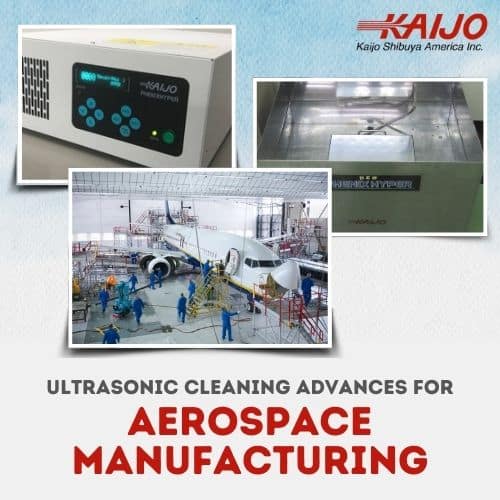
- The Phenix Hyper provides 78kHz as a normal ultrasonic wave or the aggressive Hyper Wave for strong three-dimensional cleaning.
- Eliminate FOD from internal passages that manual methods miss — preventing costly component failures and improving mission reliability in lattice structures, cooling galleries, and capillary passages that brushes and spray methods cannot reach.
- Get uniform cleaning results every time with Water Resonance System (WRS) technology — eliminates dead zones and ensures consistent cleaning forces across every part surface, achieving repeatable results that meet OEM acceptance criteria.
- Pass Pratt & Whitney audits on the first try with validated process controls and traceability records — avoiding costly requalification cycles and keeping your production on schedule.
- Cut rework and scrap rates by removing multiple soil types in a single cycle — machining coolants, EDM residue, and carbon deposits—thereby improving first-pass acceptance rates and boosting throughput without additional cleaning steps.
- Protect sensitive titanium and aluminum parts from damage — frequency and chemistry controls prevent microcracks and surface damage while delivering thorough cleaning on aerospace alloys.
- Receive complete validation support from aerospace cleaning experts — our experts help you select chemistries, define parameter windows, conduct sample trials, and build documentation packs that meet specifications.
- Scale from testing to full production without facility disruption — systems integrate seamlessly with your existing production lines and minimize downtime during installation, protecting your delivery schedules.
- Eliminate harsh solvent exposure and improve operator safety — aqueous chemistries and ergonomic designs reduce HSE risks while supporting safer facility operations and regulatory compliance.
- Achieve measurable improvements you can track — lower particle counts, restored flow rates, higher first-pass yields, and reduced cycle times that directly impact your operational efficiency and cost targets.
Get Audit-Ready Documentation That Passes Every Time
 Start with material-specific trials using test samples that match your production alloys and surface treatments—so you validate compatibility before risking production parts.
Lock in the exact parameters that consistently pass audits—frequency, power, temperature, chemical concentration, dwell time, and agitation settings—to eliminate guesswork and prevent audit failures for your specific parts.
Prove your parts meet cleanliness standards with particle counts, flow-rate restoration measurements, or surface-energy tests as specified by Pratt & Whitney or your OEM requirements—giving auditors the documented proof they demand.
Confirm no surface damage occurred with dye penetrant, eddy current, or magnified visual inspection on sensitive parts—protecting your components from microcracks while meeting inspection requirements.
Build your bulletproof audit package with parameter logs, calibration records, chemistry compatibility data, inspection results, and operator training certificates—creating audit-ready documentation that demonstrates repeatability and traceability for AS9100 and NADCAP compliance.
Get complete process engineering support, including sample trials and validation assistance, to build these evidence packages—so you don’t navigate the validation process alone.
Contact Us for a Free Consultation
Proven Results Across Critical Aerospace Applications
An aerospace ultrasonic cleaning system handles critical applications across multiple sectors:
- Commercial Aviation – Prevent costly component failures and maintain mission reliability by removing FOD from turbine blades and fuel nozzles that manual methods miss
- Defense & Military Aerospace – Eliminate contamination from mission-critical propulsion parts and weapon-system hydraulics to prevent malfunctions in harsh environments
- Space Exploration – Achieve high-purity cleaning for fluid systems and prepare cryogenic components for extreme temperature performance requirements
- Additive Manufacturing (AM) – Remove trapped powder and support structures from complex lattice designs and internal channels that other methods cannot reach
- MRO (Maintenance, Repair, Overhaul) – Strip carbon and varnish deposits from hot-section parts to restore performance and unclog screens to maintain flow rates
- Engine OEMs – Prepare surfaces for coating adhesion, remove post-EDM residue that causes quality issues, and clean precision bores to meet tight tolerances
- Composite & Advanced Materials – Clean composite tooling to prevent defects and process hybrid metal-composite assemblies without surface damage
Ready to Eliminate FOD and Pass Your Next Audit?
Complex aerospace parts must meet strict OEM specifications. Your current cleaning methods may not reach internal passages, and you need documented proof for audits.
Here’s your next step: Contact Kaijo to request a free part-cleaning evaluation. You’ll send sample components, receive documented cleaning results, and get a validation protocol tailored to your specifications—with no obligation.
You’ll know exactly how the system performs on your parts before making any decision.
What happens during your part evaluation:
- ✓ Sample testing: Send your actual production parts—turbine blades, fuel nozzles, hydraulic manifolds, or AM components.
- ✓ Documented results: Receive before-and-after analysis, including particle counts, flow-rate measurements, and visual inspection results.
- ✓Process parameters: Get a validated cleaning protocol with specific frequency, power, chemistry, and time settings for your parts and soils.
- ✓Compliance documentation: Obtain the data format you need for your AS9100 or NADCAP documentation requirements.
- ✓ Application engineering support: Work directly with experts who understand aerospace cleaning specifications and OEM requirements.
Contact Kaijo’s support team to schedule your evaluation or call for immediate assistance with your specific cleaning challenge.
Request a Part Cleaning Evaluation
Articles & Resources
Learn more about aerospace ultrasonic cleaning applications:


FAQ’s About Ultrasonic Cleaning Technology
You can effectively clean turbine blades, fuel nozzles, hydraulic manifolds, landing gear components, heat exchangers, avionics housings, valve assemblies, additive manufacturing parts with lattice structures, and components with internal cooling passages or blind bores. The technology works across aluminum, titanium, nickel alloys, stainless steel, brass, ceramics, and composite materials.
Ultrasonic cleaning generates microscopic bubbles that implode with high energy, creating non-contact cleaning forces that penetrate internal passages, cooling holes, capillaries, and complex geometries that brushes, spray wands, and manual methods cannot reach. This removes trapped particles, oils, machining residues, and carbon deposits that pose a risk of foreign-object damage to your components.
Yes, if you use the wrong settings or frequencies, parts can be damaged. You can protect sensitive materials by selecting higher frequencies (120-160 kHz for delicate parts), controlling power levels, and using compatible chemistries. Before running production parts, you should validate your process with test samples and NDT verification to confirm that no damage occurs. You'll receive material-specific guidance to prevent microcracks on your titanium, aluminum, or nickel alloy components.
Lower frequencies (26–38 kHz) provide aggressive cleaning to remove bulk soils and heavy carbon deposits on hard, robust parts. Higher frequencies (100–160 kHz) deliver gentler, precision cleaning for delicate components, thin-walled structures, and fine surface finishes. Multi-frequency systems allow you to combine both processes sequentially—bulk removal followed by precision finishing—for optimal results on your parts.
OEM specifications typically require validated process parameters, material compatibility data, documented inspection criteria, and traceability records. You'll need to establish parameter windows (frequency, power, temperature, chemistry, dwell time), conduct qualification trials with test samples, perform required NDT inspections, and build documentation packs that demonstrate repeatability and compliance with AS9100 and NADCAP standards. Engineering support is available to help you through each validation step.
Aqueous alkaline solutions remove oils, greases, and machining coolants. Neutral-pH detergents protect sensitive alloys such as aluminum. Acidic formulations address oxidation and scale. You should select chemistries based on your soil type, base material, surface treatment, and OEM compatibility requirements. Always verify chemistry-material compatibility and include concentration, temperature, and bath-life data in your process documentation.
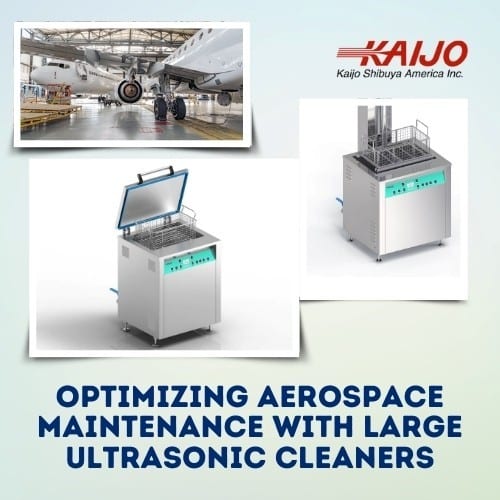
Your tank sizing depends on your largest parts, batch quantities, and fixturing requirements. Large ultrasonic cleaners for MRO can accommodate turbine sections, long manifolds, and landing gear assemblies. Custom tank designs are available with automated lift-and-rotate systems, multi-zone configurations, and integration to your existing production lines. You can get application-specific sizing and layout recommendations based on your actual parts and throughput requirements.
Yes. Ultrasonic cleaning forces reach internal lattice structures, support material remnants, and unsintered powder trapped in channels that other cleaning methods cannot access. Higher frequencies combined with appropriate chemistries and agitation remove AM residues without damaging delicate geometries, making ultrasonics ideal for your post-build cleaning and pre-coating surface prep.
You'll need to compile process parameter specifications, equipment calibration logs, chemistry safety data sheets and compatibility matrices, operator training records, test sample results, NDT inspection reports, particle count or flow rate verification data, batch traceability records, and change control procedures. This evidence pack supports your AS9100, NADCAP, FAA, NASA, and OEM audit requirements.
WRS technology enhances acoustic field uniformity throughout the cleaning tank, eliminating dead zones and ensuring consistent cleaning forces at every part surface. This improves your cleaning repeatability, reduces cycle-to-cycle variation, and supports your process validation requirements by delivering predictable, documented performance that satisfies OEM and agency acceptance criteria.