

Water Resonance System — Ultrasonic Industrial Cleaning Equipment for Uniform Cavitation
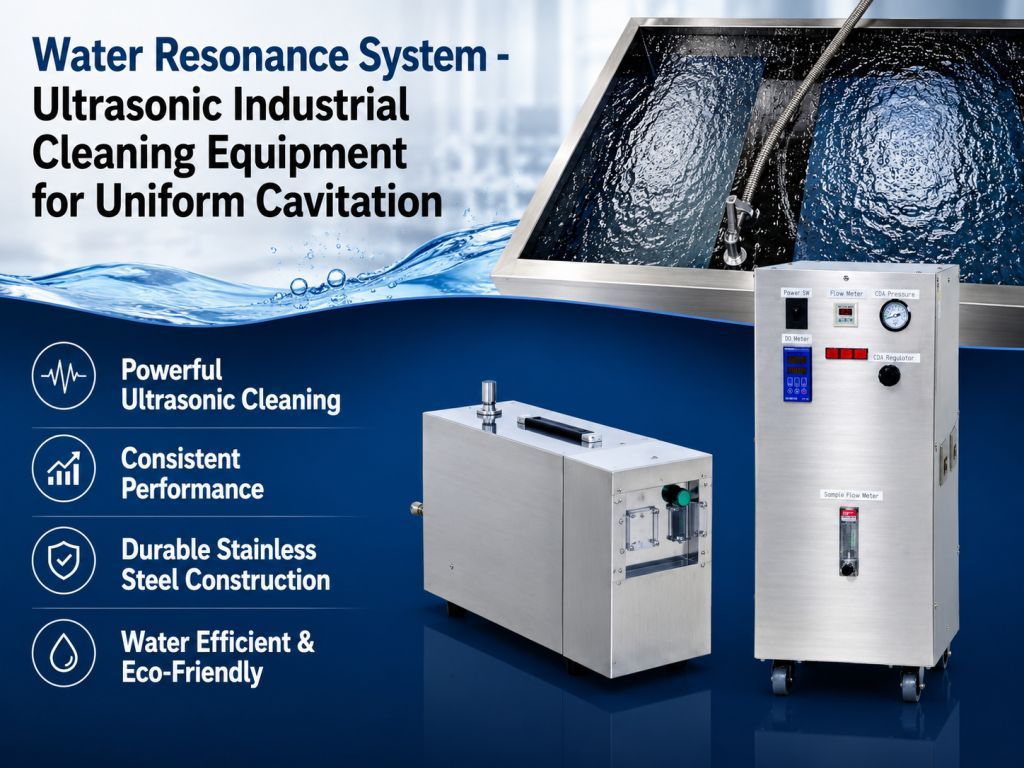
Kaijo’s Water Resonance System (WRS) is ultrasonic industrial cleaning equipment that can be added to any existing industrial ultrasonic cleaner, increasing cavitation energy by up to 500% and delivering faster, more uniform cleaning without replacing your current system. Recognized with the Acoustical Society of Japan Engineering & Development Award in 2007, the WRS is a proven solution for manufacturers seeking measurable improvements in cleaning efficiency, part quality, and operational costs.
Our engineers will help you determine if the WRS is the right addition to your cleaning process.
Request a Free Process Consultation
What the Water Resonance System Does and How It Works
Most industrial ultrasonic cleaners concentrate cavitation energy directly above the transducer, leaving areas of the cleaning tank with uneven cleaning intensity. Adding the WRS to an existing industrial ultrasonic cleaner addresses this limitation at the source.
The WRS conditions the cleaning bath by removing dissolved gas from the solution. Dissolved gas produces bubbles that are incorrectly sized, attenuating the ultrasonic signal before it can perform useful cleaning. By eliminating these bubbles, the WRS optimizes cavitation bubble formation and distributes ultrasonic energy uniformly throughout the entire tank.
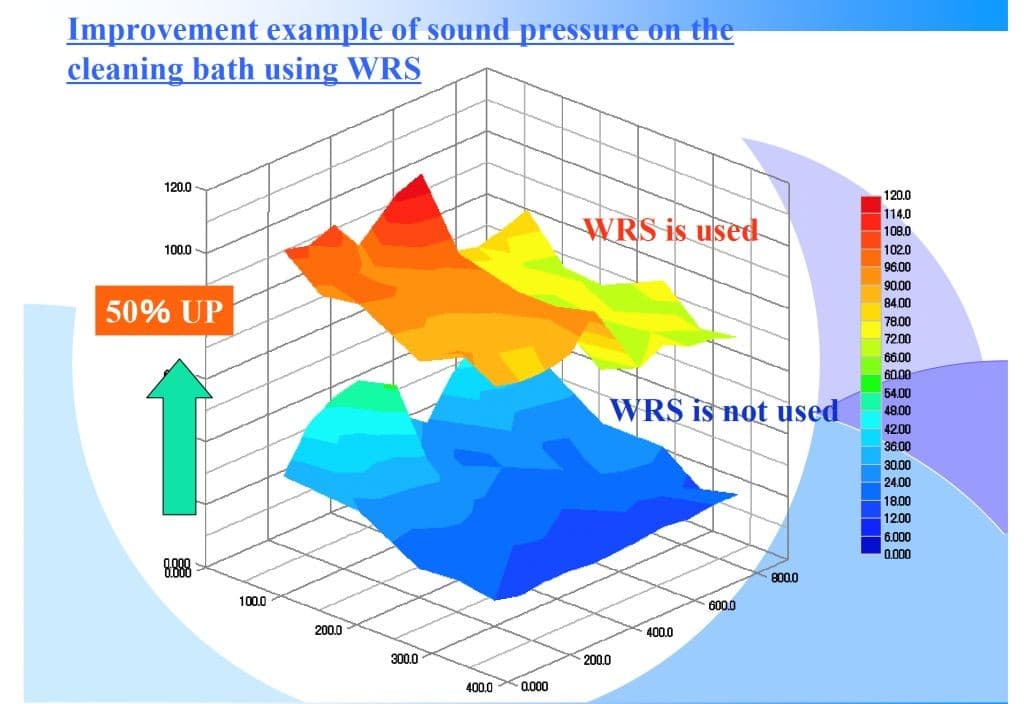
The result is a cleaning bath with up to 5× greater acoustic pressure than a system operating without WRS. The graph below, based on Kaijo’s published test data, shows the measured improvement in sound pressure in the cleaning bath when WRS is in use compared with when it is not.
The visual impact is equally clear. The side-by-side tank comparison below shows the cleaning bath without WRS on the left — a relatively inactive bath with cavitation concentrated near the transducer — and with WRS on the right, where the bath shows visibly more turbulent, dynamic cleaning action distributed uniformly throughout the tank.
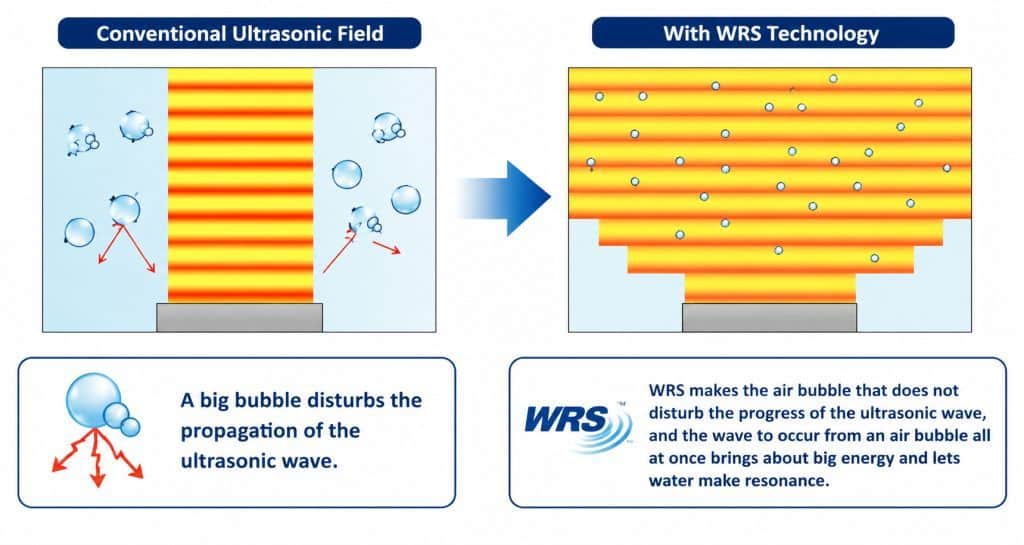
Left: Large air bubbles from dissolved gas disrupt ultrasonic wave propagation, reducing cleaning effectiveness.
Right: The WRS produces small, uniform bubbles that allow waves to propagate fully throughout the tank, generating consistent cavitation energy.
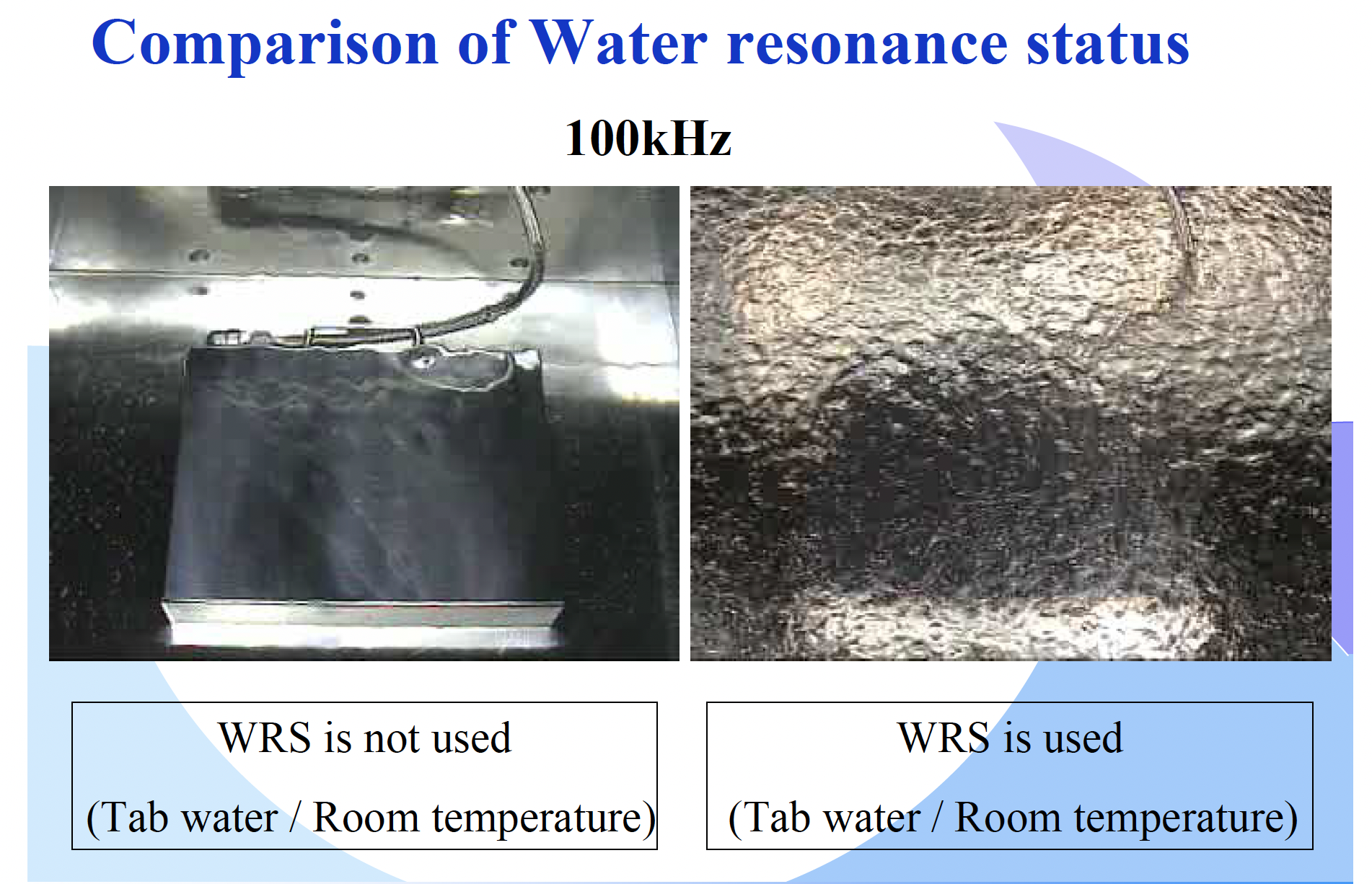
Cleaning is faster, more uniform, and more consistent across every part in the bath, regardless of its position in the tank.
Adding the WRS to Any Existing Ultrasonic Industrial Cleaning Equipment
The WRS is not a standalone cleaner. It is ultrasonic industrial cleaning equipment designed to be added to any existing industrial ultrasonic cleaner — from any manufacturer — delivering performance improvements without requiring a full system replacement.
Compatible cleaning applications include:
- Machined parts and post-heat-treated parts
- Wires and ceramic components
- HDD components, metal, and glass parts
- Complex geometries and cylinders where standard ultrasonic waves cannot fully reach
The WRS is available in two configurations — WRS (standard) and WRS-F (flow) — each with three models spanning different temperature, power, and liquid capacity ranges. No field matching is required for horn changeout, which lowers installation complexity and reduces the risk of production disruption during adoption.
Request a Free Process Consultation
Key Features and Performance Advantages of the WRS
The Water Resonance System delivers a measurable set of technical advantages over conventional immersible transducers when added to an existing industrial ultrasonic cleaner:
- 5× greater sound pressure than systems operating without WRS — the primary driver of enhanced cleaning efficiency
- Uniform ultrasonic wave distribution throughout the entire tank — eliminating uneven zones that limit conventional systems
- Three-dimensional cleaning capability inside cylinders and complex geometries where standard ultrasonic waves cannot completely reach
- Less operational noise than conventional ultrasonic systems
- Heat-resistant to 60°C at the transducer — suitable for elevated-temperature cleaning processes
- 3–10× longer product lifetime than conventional models due to reduced erosion rates
- Compatible cleaning liquids: city water, pure water, ionic water, and deionized water (WRS); deionized water (WRS-F)
Measurable Results — Efficiency, Quality, and Cost Impact
Adding the WRS to existing ultrasonic industrial cleaning equipment delivers quantifiable performance gains for process and manufacturing engineers, and directly addresses operating cost and environmental compliance objectives for facilities managers.
- Up to 500% increase in cavitation energy compared to a standard industrial ultrasonic cleaner operating without WRS — producing more intensive cleaning action without increasing surface damage risk
- Uniform cavitation distribution reduces the risk of localized surface damage — a critical quality control benefit for precision-machined parts and delicate components
- Reduced chemical consumption: the WRS has enabled customers to eliminate hazardous acid and solvent-based cleaning processes entirely, replacing them with ultrasonic cleaning using only deionized water
- Less water usage and lower energy requirements — aligned with environmental compliance goals and sustainability initiatives
Kaijo’s team of experts works directly with clients to validate parameters before full production implementation, reducing adoption risk and establishing a documented process baseline before the first production run.
Request a Free Process Consultation
WRS Models and Specifications
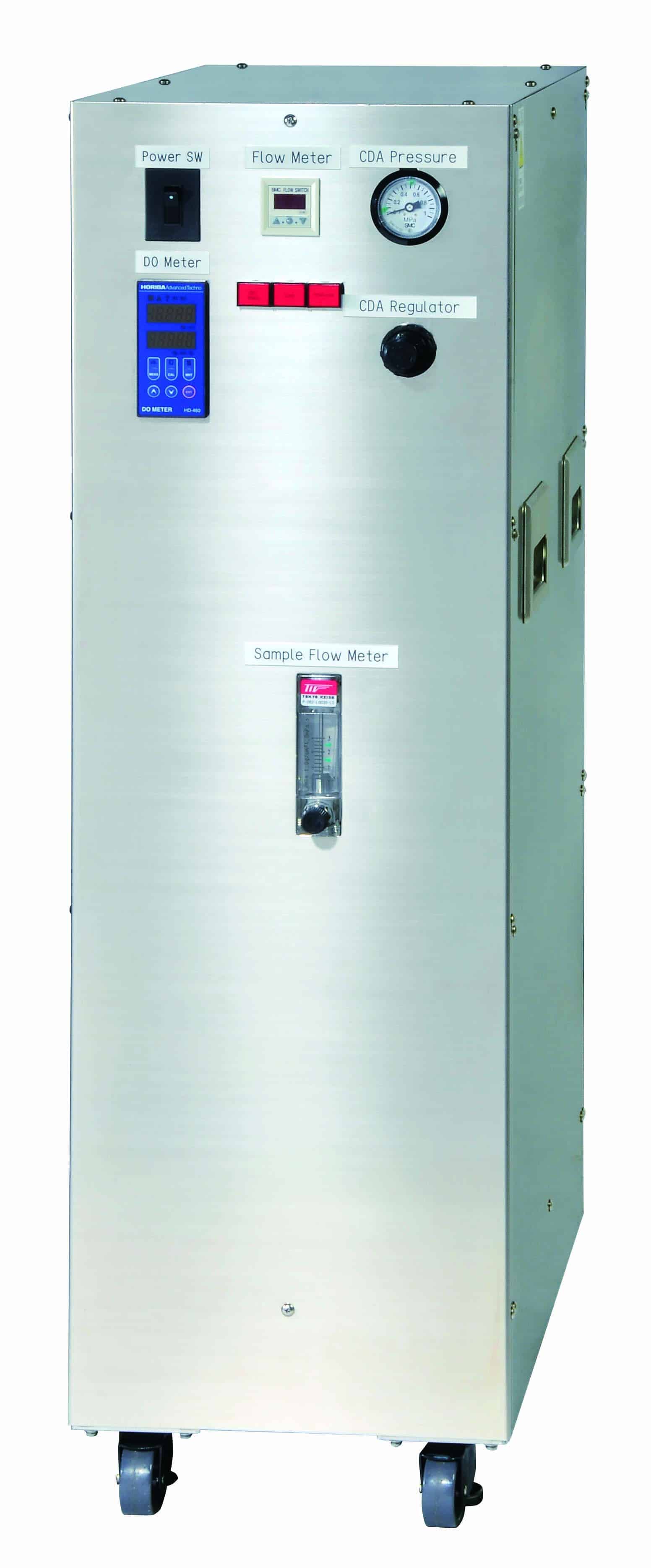
The WRS and WRS-F systems are each available in three configurations, designed to accommodate different temperature ranges, power requirements, and liquid capacities. Kaijo’s engineering team can identify the right model for your specific application, tank size, and production volume.
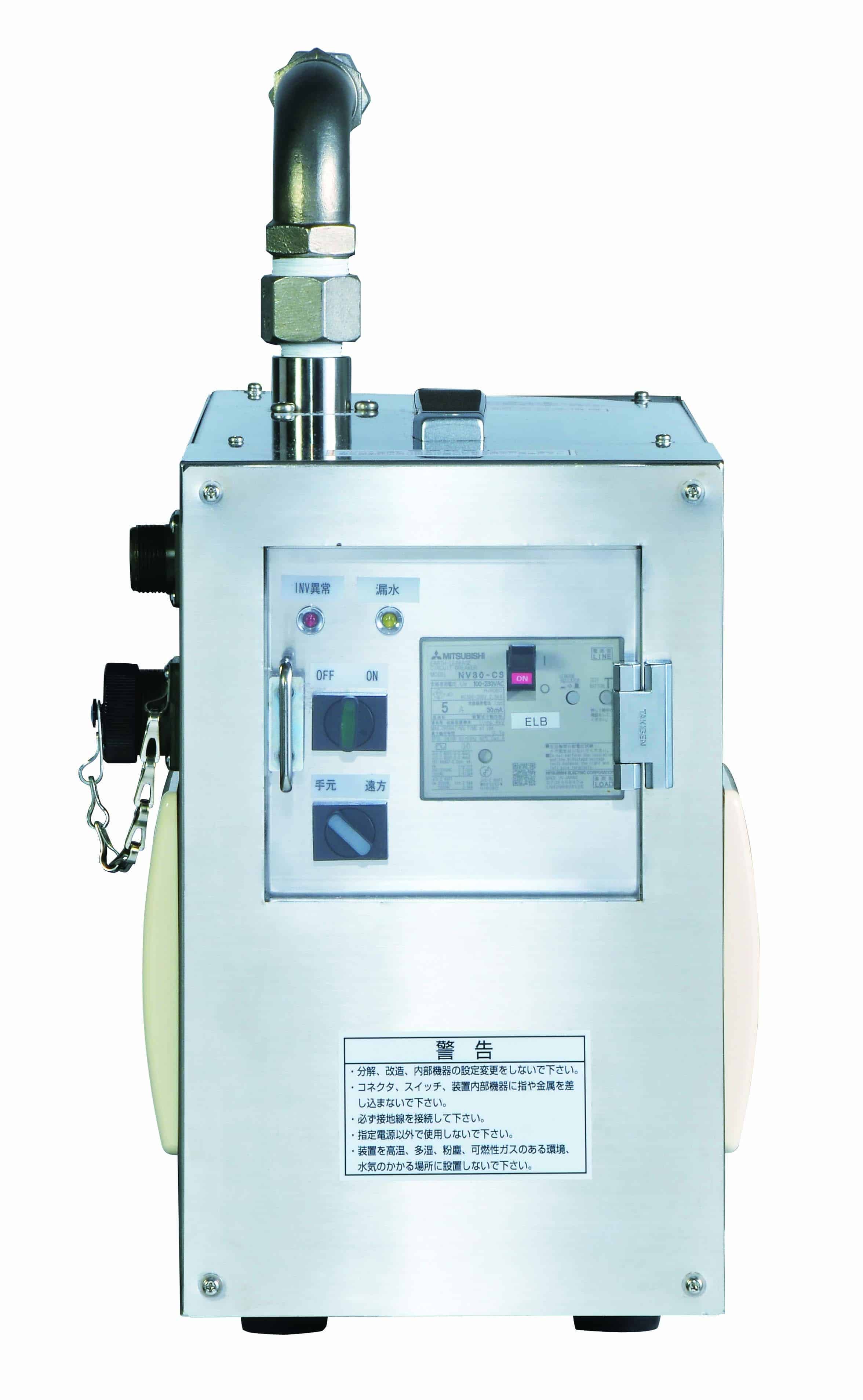
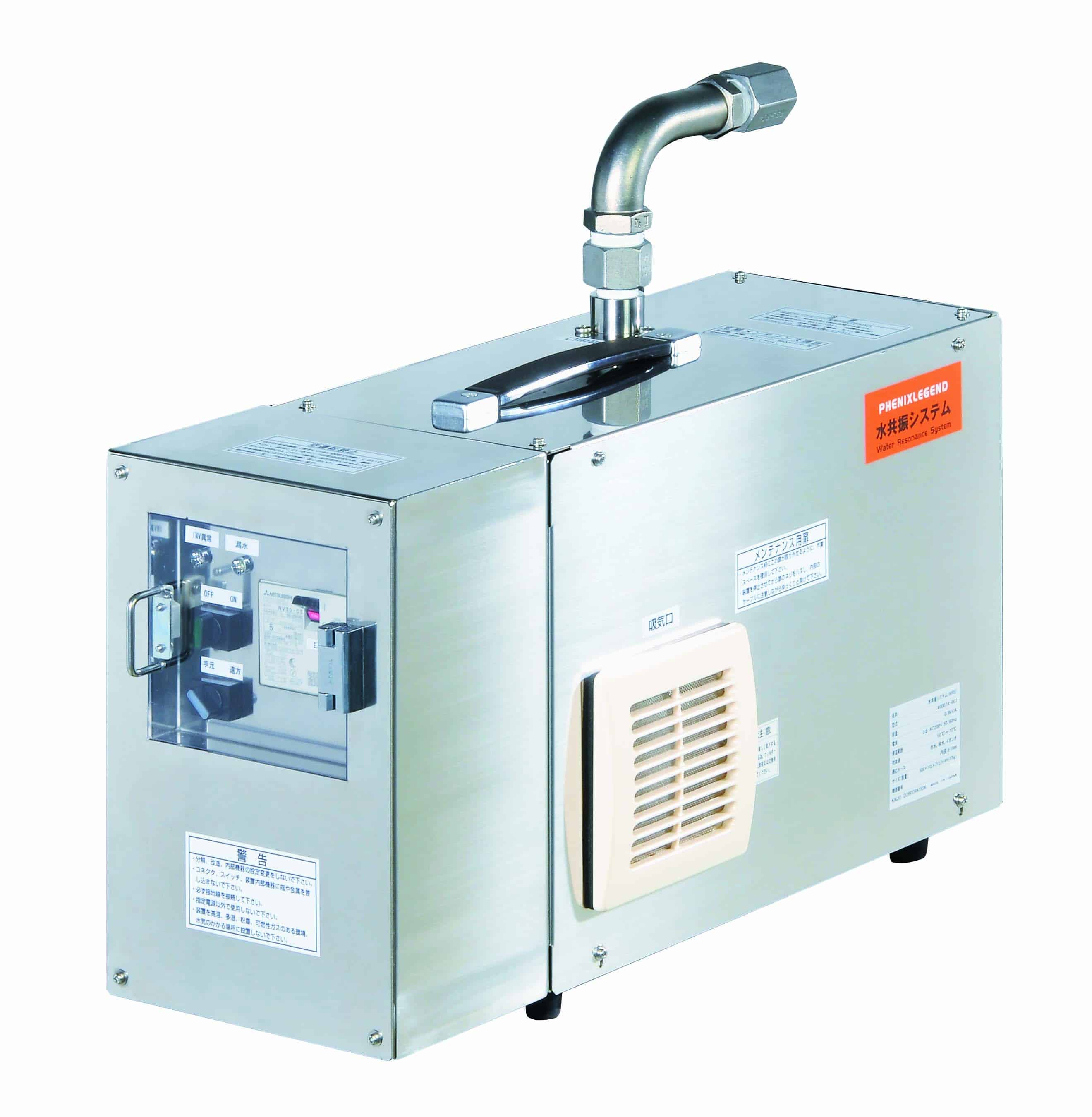
W R S Specifications

W R S – F Specifications
Frequently Asked Questions About the Water Resonance System
Yes. The WRS is ultrasonic industrial cleaning equipment designed to be added to any existing industrial ultrasonic cleaner, not just Kaijo's own systems. It integrates with equipment from any manufacturer, improving cavitation uniformity and cleaning efficiency without requiring a full system replacement. No field matching is required for horn changeout, which simplifies installation and minimizes production disruption.
Standard industrial ultrasonic cleaners concentrate cavitation energy directly above the transducer. The WRS conditions the cleaning bath by removing dissolved gas, which produces incorrectly sized bubbles that attenuate the ultrasonic signal. By eliminating these bubbles, the WRS distributes cavitation uniformly throughout the entire tank, increasing acoustic pressure by up to 5× and raising cavitation energy by over 500%.
The WRS is suitable for HDD components, machined metal parts, post heat-treated parts, wires, ceramics, and glass. Its three-dimensional cleaning capability makes it particularly effective for cylinders and complex geometries where standard ultrasonic waves cannot fully penetrate. Compatible cleaning liquids include city water, pure water, ionic water, and deionized water.
No. Horn changeout requires no field matching, minimizing installation time and disruption. The WRS is available in both standard (WRS) and flow (WRS-F) configurations to fit different system setups. Kaijo's application engineers work with your team through the integration process to validate parameters and establish a production baseline before full implementation.
The WRS increases the efficiency of any existing industrial ultrasonic cleaner by up to 500%, reducing the amount of cleaning chemistry needed to reach target cleanliness levels. In documented customer applications, the combination of WRS and deionized water has eliminated the need for hazardous acid or solvent-based cleaning processes entirely — removing associated chemical handling, storage, and disposal costs and improving workplace safety.
Articles & Resources:
Learn more about the Water Resonance System and ultrasonic industrial cleaning:
How WRS Technology Transforms Efficiency in Industrial Cleaning
Why Kajios WRS is Needed For Some Ultrasonic Cleaning Applications
Maximizing Ulrasonic Cleaning Performance with Kajios WRS Technology
Contact Kaijo to Learn More
Kaijo Shibuya America has over 70 years of experience in ultrasonic engineering, with factory-direct application support from Santa Clara, California. Our technical experts work with your team to evaluate your specific cleaning requirements, validate system fit, and establish process parameters before full production implementation.