



How an Ultrasonic Cleaner for Electronics Reduces Defects
Written by: Michael Danese | May 5, 2026
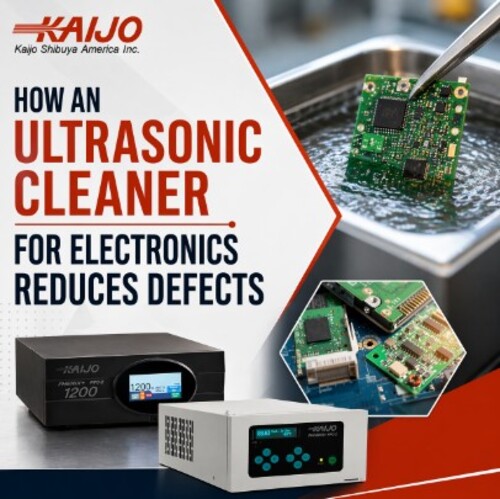 Flux residues, ionic contamination, and particulates are among the leading causes of PCB field failures. This article covers how an ultrasonic cleaner for electronics removes these contaminants from complex component geometries and which process parameters determine whether cleaning is validated or variable.
Table of Contents
- Introduction: Why Contamination Control Determines Electronic Component Reliability
- How Ultrasonic Cleaning Works for Electronic Components
- Key Contaminants and Their Impact on Product Reliability
- Best Practices for Using an Ultrasonic Cleaner for Electronics
- Choosing the Right Industrial Ultrasonic Cleaner
- Frequently Asked Questions
1. Introduction: Why Contamination Control Determines Electronic Component Reliability
Contamination is one of the most persistent threats to electronic component reliability. Flux residues, particulates, oils, and ionic contaminants accumulate during manufacturing and, if left uncleaned, lead to short circuits, signal degradation, and premature field failures.
An ultrasonic cleaner for electronics addresses these challenges through acoustic cavitation, a process detailed in Section 2, which generates a cleaning action across every surface of a component, including areas that manual or solvent-based methods cannot consistently reach. Unlike spray or manual cleaning, ultrasonic systems clean all submerged surfaces in a cleaning tank simultaneously, including blind vias, under-component cavities, and fine-pitch pads where contamination accumulates but hands and nozzles cannot reach.
For process engineers focused on quality, throughput, and repeatability, ultrasonic cleaning offers a scalable, precision-controlled alternative to conventional methods. Industrial Ultrasonic cleaners deliver consistent results across batch production runs without the variability that makes manual cleaning difficult to validate.
2. How Ultrasonic Cleaning Works for Electronic Components
Ultrasonic cleaning operates on the principle of acoustic cavitation. An ultrasonic generator converts electrical energy into high-frequency sound waves, which are transmitted into a liquid cleaning bath through transducers mounted to the tank. These sound waves create millions of microscopic bubbles that rapidly expand and implode, releasing concentrated energy in the form of pressure waves and localized liquid jets. This dislodges and removes contaminants from component surfaces, including blind holes, crevices, and complex geometries without mechanical abrasion.
Key advantages over manual and solvent cleaning methods:
- Consistency: Eliminates operator-to-operator variability, making the cleaning step repeatable and audit-ready across every batch.
- Reach: Cleans blind vias, under-component pads, and complex geometries simultaneously, no fixturing or manual repositioning required.
- Speed: Predictable, automated cycle times increase throughput and reduce labor cost per unit cleaned.
- Reduced chemical dependence: Lower-concentration solutions reduce chemical cost, waste disposal overhead, and compliance exposure.
Kaijo’s industrial ultrasonic cleaners use advanced generator technology to deliver precise control of frequency and power, which is essential when cleaning sensitive electronic components.
3. Key Contaminants and Their Impact on Product Reliability
Each contaminant type in electronics manufacturing carries a distinct failure mode. Misidentifying the contamination source — or skipping characterization — means cleaning parameters are guessed rather than validated. Ionic contamination and particulates that pass inspection cause failures downstream in conformal-coating adhesion, underfill integrity, and final-assembly yield, resulting in significantly higher rework costs.
| Contaminant | Source | Failure Mode | Cleaning Priority |
| Ionic flux residue | PCB soldering | Leakage current, electrochemical migration, dendritic growth | Critical |
| Particulates | Machining, ambient handling | Intermittent shorts, mechanical interference | High |
| Oils/lubricants | Metal handling, machining | Adhesion failure, conductivity loss in downstream steps | Medium |
Investing in proper electronic component cleaning reduces defect rates, extends product service life, and protects the integrity of downstream manufacturing steps.
4. Best Practices for Using an Ultrasonic Cleaner for Electronics
An incorrect frequency selection can damage Micro-Electrical-Mechanical System (MEMS) devices. The wrong cleaning solution can degrade polymer housings or strip surface finishes. Process parameters in ultrasonic cleaning for electronics are not optional calibrations – they are the difference between a validated process and a rework loop.
Frequency Selection
Frequency is the most critical parameter. Use the table below to match frequency to your component type and contamination profile:
| Frequency Range | Best For | Avoid For |
| 20–40 kHz | Heavy contamination on robust metal parts | MEMS, fine wire bonds, fragile ceramics |
| 40–80 kHz | General PCB cleaning, connectors, assemblies | Very fine-pitch or exposed wire bonds |
| 80–130 kHz | Delicate PCBs, precision optical components | Applications requiring aggressive cavitation |
| 130 kHz+ | MEMS, bare wafers, ultra-precision parts | Any heavy contamination removal |
Cleaning Solution Compatibility
Aqueous solutions with appropriate surfactants or detergents are widely used for flux residue removal. The selected solution must be chemically compatible with all materials present, including base metals, surface finishes, polymers, and adhesives. Consult component and materials specifications before selecting a chemistry.
Process Parameters
- Temperature: Elevated bath temperature (typically 40–60°C) reduces surface tension and improves solubility. Optimal temperature depends on the solution chemistry and component materials.
- Cycle time: Duration should achieve the required cleanliness level without exposing components to unnecessary cavitation energy.
- Agitation: Mechanical basket agitation or ultrasonic sweep functions ensure uniform cavitation distribution. For high-density assemblies with significant shadowing, agitation prevents cleaning dead zones.
- Rinsing and drying: A thorough rinse removes dissolved contaminants and cleaning chemistry residues. Proper drying, forced-air or controlled-heat, prevents recontamination and moisture-related failures.
For operations required to meet assembly cleanliness specifications, process parameters should be validated in accordance with IPC J-STD-001. This is the globally recognized standard for soldered electrical and electronic assemblies, which includes cleaning and residue requirements. Kaijo works directly with customers to determine the appropriate frequency, power level, and system design for each application, ensuring process parameters are validated before production deployment.
5. Choosing the Right Industrial Ultrasonic Cleaner
Selecting an industrial ultrasonic cleaner for electronics production is a capital decision that affects cleaning yield, process validation timelines, and total cost of ownership. Evaluate frequency control, throughput capacity, generator stability, and integration requirements — in that order of technical priority.
- Frequency range and control: Adjustable or sweep frequency lets a single system handle multiple component types — critical for mixed-production environments where component sensitivity varies by product line.
- Tank size and throughput capacity: Specify your largest batch geometry and expected cycle rate before evaluating ultrasonic cleaning tank Undersized tanks can create cavitation dead zones, while oversized tanks waste energy and solution.
- Generator performance: Generator stability directly affects batch-to-batch cleaning consistency. Kaijo’s Phenix+ and Phenix Hyper generators are engineered for precise, stable power delivery in demanding applications.
- Automation and integration: Automated transfer between ultrasonic, rinse, and dry stages eliminates recontamination risk and reduces labor cost. Systems that integrate with robotic loading and conveyor lines support higher throughput.
- Customization and application support: Kaijo’s team configures systems to match specific cleaning requirements, including multi-stage systems with rinse and drying stations.
- Optimized waveforms: The Phenix Hyper Hyper Wave mode delivers uniform cavitation energy for complex 3D geometries, while Phenix+ FM Modulation eliminates standing waves and hot spots for more even energy distribution across the bath.
Kaijo also offers the Water Resonance System (WRS), which increases the cavitation effect by up to 500% compared to standard ultrasonic output. This is effective for contamination profiles that standard ultrasonics alone cannot address.
Total Cost of Ownership: A properly matched system reduces rework rates, extends solution life through lower chemical concentration requirements, and minimizes unplanned downtime. In high-volume production environments, even a 1% reduction in the rework rate can recoup system costs within months.
Key Benefits of Ultrasonic Cleaning for Electronics
Contamination control is not a secondary concern in electronics manufacturing — it is a direct determinant of product reliability, yield, and service life. As component geometries become more complex and cleanliness requirements more stringent, ultrasonic cleaning for electronics manufacturing becomes an essential process step, not an optional one.
- Consistent removal of flux residues, ionic contamination, particulates, and oils
- Eliminates cleaning dead zones on high-density assemblies where ionic contamination most commonly survives to cause field failures
- Scales with production volume — from R&D validation batches to high-throughput inline configurations — without revalidating the cleaning process
- Reduced rework costs and improved long-term product reliability
- Precision frequency and power control for delicate or high-value components
Kaijo’s support team evaluates your specific component types, contamination profile, and production volume to recommend a configured system rather than a catalog selection. Contact Kaijo for a free consultation to discuss your application requirements.
Prefer to start with specs? Refer to Kaijo’s technical documentation for the Phenix+, Phenix Hyper, or Phenix Legend II generator series.
6. Frequently Asked Questions
Q1: Is ultrasonic cleaning safe for delicate electronic components?
Ultrasonic cleaning is safe for most electronic components when the correct frequency and power settings are applied. For general PCB and connector cleaning, 80–100 kHz is appropriate. For MEMS devices, wire bonds, and extremely fine-pitch assemblies, 100 kHz or higher is preferred. Components with known sensitivity to cavitation, such as certain ceramic resonators or unsealed connectors, should be evaluated individually before process validation.
Q2: What frequency is best for cleaning electronic components?
The optimal frequency depends on the component type and contamination level. Frequencies in the 40–80 kHz range are commonly used for general PCB and connector cleaning. For finer or more fragile components, 80–100 kHz is the practical threshold, with 100 kHz or higher preferred for MEMS and ultra-precision parts. Kaijo offers systems across a broad frequency range and can assist in selecting the appropriate setting for each application.
Q3: What cleaning solutions are compatible with electronics?
Aqueous cleaning solutions with appropriate surfactants or detergents are widely used, particularly for flux residue removal. The selected solution must be chemically compatible with all materials present on the component, including base metals, surface finishes, polymers, and adhesives. Solvent-based solutions may be used in specific applications but require careful handling and a review of regulatory compliance.
Q4: How does ultrasonic cleaning improve product reliability?
By removing ionic contaminants, flux residues, and particulates that cause corrosion, leakage currents, and mechanical interference, ultrasonic cleaning directly reduces the root causes of electronic field failures. Consistent cleaning also supports downstream process steps, including conformal coating, underfill, and soldering, by ensuring surface conditions meet specifications before each stage.
Q5: Can ultrasonic cleaning be integrated into automated production lines?
Yes. Industrial ultrasonic cleaners can be configured for inline or automated operation, including integration with robotic loading systems, automated conveyors, and multi-stage rinse-and-dry modules. Kaijo Shibuya works with engineering teams to design systems that fit existing production line layouts and throughput requirements.