



Choosing the Right Frequency for Industrial Ultrasonic Cleaners
Written by: Michael Danese | June 4, 2026
 This guide explains how to match ultrasonic cleaning frequency to your materials, contaminants, and process goals so you can specify the right system the first time.
A cleaning line runs the same chemistry, the same cycle time, and the same operators it always has, yet results drift. One batch comes out spotless; the next leaves residue in blind holes, or worse, shows surface damage on delicate parts. Before you change detergents or extend cycle times, look at the variable most often overlooked: frequency.
Frequency determines how cavitation behaves inside the tank, the size of the bubbles, the energy they release, and the surfaces they can reach. Get it right, and industrial ultrasonic cleaners deliver fast, repeatable, non-contact cleaning. Get it wrong, and the same physics that removes contamination can erode soft metals or miss tight geometries entirely.
Table of Contents
- Understanding Ultrasonic Cleaning Frequency — The Basics
- Matching Frequency to Material and Contaminant Type
- How Power Density, Temperature, and Chemistry Interact with Ultrasonic Cleaning Technology
- Industry-Specific Frequency Applications and Kaijo’s Recommendations
- How to Evaluate and Select the Right Ultrasonic Cleaning System for Your Process
- Frequently Asked Questions
1. Understanding Ultrasonic Cleaning Frequency — The Basics
Ultrasonic cleaning works through cavitation, the rapid formation and collapse of microscopic bubbles created when high-frequency sound waves pass through a liquid. As each bubble implodes against a contaminated surface, it releases a focused burst of energy that lifts away oils, particulates, flux, and films. Because the liquid carries that energy everywhere it touches, cavitation reaches recesses, blind holes, and complex geometries that spray washing and manual scrubbing cannot.
Frequency controls the character of that cavitation. Lower frequencies produce larger, higher-energy bubbles, and higher frequencies produce smaller, gentler, more numerous bubbles. That single relationship governs both cleaning power and the risk of surface damage.
Industrial ultrasonic cleaning generally spans from 20 kHz to 200 kHz, with the most commonly specified frequencies being 26 kHz, 38 kHz, 78 kHz, and 130–160 kHz. A useful way to think about the spectrum:
- 20–40 kHz — aggressive cleaning: large, high-energy bubbles that strip heavy contamination from robust parts in fewer cycles.
- 68–120 kHz — precision cleaning: smaller bubbles that clean densely featured parts and tight geometries thoroughly while lowering the risk of surface damage.
- 130 kHz and above — ultrafine cleaning: very small bubbles that remove submicron particles from delicate surfaces and fine features without stressing them.

A key differentiator for Kaijo is full-spectrum coverage. As one of the established ultrasonic cleaner manufacturers serving precision industries, Kaijo offers systems across the low-, mid-, and high-frequency ranges, as well as megasonic systems for semiconductor wafer cleaning that operate well above the ultrasonic band. That breadth means the frequency is matched to the application rather than forcing the application to fit a single fixed frequency.
2. Matching Frequency to Material and Contaminant Type
This is the technical heart of frequency selection. Two questions drive the decision: how durable is the substrate, and how heavy is the contamination? Robust parts with stubborn soils tolerate and need high-energy, low-frequency cavitation. Delicate parts and fine features require gentler, higher-frequency energy that cleans without eroding surfaces.
The table below gives general starting points. Always validate against representative parts before committing to production parameters.
| Material / Component | Typical Contaminant | Suggested Frequency | Rationale |
| Steel, titanium, brass machined parts | Cutting oils, grinding paste, chips | 26–38 kHz | Durable surfaces tolerate high-energy cavitation for heavy soils |
| Aluminum and soft metals | Machining oils, polishing compound | 78–160 kHz | Higher frequency reduces the risk of cavitation erosion on soft surfaces |
| PCBs and electronic assemblies | Flux residue, ionic contamination | 38–160 kHz (by density) | Frequency rises as component density and sensitivity increase |
| Semiconductor wafers and optics | Submicron particles, films | 160 kHz–megasonic | Smallest bubbles remove fine particles without surface damage |
| Aerospace and automotive components | Carbon, lubricants, particulates | 26–78 kHz | Frequency set by part geometry and contamination load |
| Starting points only — validate on representative parts before locking production parameters. |
The consequences of a mismatch are real. A frequency that is too low for a delicate part can pit, erode, or stress fragile features, which is a particular concern for aluminum, thin films, wire bonds, and optical surfaces. A frequency that is too high for heavily soiled, robust parts will not deliver sufficient energy, leaving residue behind and extending cycle times. Because Kaijo designs systems across the full range, the recommendation follows the part rather than a one-frequency catalog.
3. How Power Density, Temperature, and Chemistry Interact with Ultrasonic Cleaning Technology
Frequency does not work alone. Effective ultrasonic cleaning technology balances several interdependent variables, and changing one shifts the others. The four levers below should be tuned together, not in isolation.
| Variable | What it controls | Get it wrong and… |
| Power density | Cleaning energy delivered into the tank volume must scale with tank size, load, and contamination. | Too little: weak, uneven cavitation. Too much concentrated energy: damage to sensitive parts. |
| Temperature | Cavitation efficiency; most aqueous chemistries peak in a mid-range band (commonly ~40–65 °C). | Near boiling, cavitation is suppressed; too cold, soils don’t release. |
| Chemistry | Compatibility with the part and the ultrasonic field; pH-neutral suits most general cleaning. | Ultrasonic energy amplifies chemical attack — a “safe” soak can damage coatings or soft metals when energized. Degas to keep cavitation strong. |
| Tank geometry & transducer placement | How uniformly does energy reach the load? | Dead zones leave parts under-cleaned. |
Kaijo addresses these directly. The Phenix+ delivers up to 1,200 watts while drawing no more than 7 amps, with auto-calibration and auto-tuning that hold efficiency steady as load conditions change. The Phenix Hyper offers a Hyper mode that distributes cavitation three-dimensionally across complex geometries. Because these variables are interdependent, Kaijo takes a consultative engineering approach — tuning frequency, power, temperature, chemistry, and tank design together.
4. Industry-Specific Frequency Applications and Kaijo’s Recommendations
Different industries cluster around different frequency profiles. Below are common application patterns and the industrial ultrasonic cleaners Kaijo typically specifies for each.
Aerospace and Automotive Components
Engine parts, hydraulic components, turbine hardware, and machined assemblies carry carbon deposits, lubricants, and machining residues on durable substrates. These respond well to low-frequency, high-energy cavitation in the 26–38 kHz range.
Recommended system: Phenix+ (26 kHz and 38 kHz, up to 1,200 W) — its normal and modulation oscillation modes and adjustable sweep frequency give process engineers flexibility for varied part loads and heavy contamination.
Electronics and PCB Manufacturing
Populated boards, connectors, and power modules require flux and ionic residue to be removed without damaging components. As density and sensitivity rise, so does the appropriate frequency from 38 kHz for robust boards up to 100–160 kHz for fine-pitch assemblies. See Kaijo’s dedicated guidance on the ultrasonic cleaner for electronics manufacturing application page.
Recommended systems: Phenix Hyper (78 kHz, 1,200 W) for high-density boards, and Phenix Legend II (100/130/160 kHz) for fine-pitch and sensitivity-critical assemblies.
Semiconductor, Optics, and Precision Components
Wafers, optical surfaces, and hybrid circuits demand the smallest, gentlest cavitation to remove submicron particles without surface stress. These applications call for frequencies above 160 kHz, extending into the megasonic range for the most demanding wafer cleaning.
Recommended system: Phenix Legend II (100/130/160 kHz) for high-frequency precision cleaning, with megasonic systems available for semiconductor wafers.
When standard configurations do not fit a part or throughput target, Kaijo can build custom ultrasonic cleaning systems engineered to the application.
5. How to Evaluate and Select the Right Ultrasonic Cleaning System for Your Process
A structured approach removes guesswork from system selection. Process engineers can work through these five steps before engaging a supplier.
- Define the substrate. Identify every material in the load — steel, aluminum, titanium, ceramics, plastics, plated finishes, or sensitive electronics. The most fragile material in the batch sets the upper limit on cavitation energy.
- Identify the contaminant. Characterize the soil: machining oils, polishing compound, flux, carbon, or fine particulates. Heavier, more tenacious soils push toward lower frequencies; light films and particles push toward higher ones.
- Establish process constraints. Document throughput, batch size, cycle-time targets, available footprint, and any cleanliness standards you must document. These define tank size, power density, and automation needs.
- Evaluate frequency options. Map substrate and contaminant against the frequency tiers — aggressive, precision, or ultrafine. Where a load mixes durable and delicate parts, a system offering adjustable or multiple frequencies provides margin.
- Engage a knowledgeable manufacturer. The right partner validates parameters on representative parts to confirm cleaning effectiveness before purchase. This is where experienced ultrasonic cleaner manufacturers earn their value.
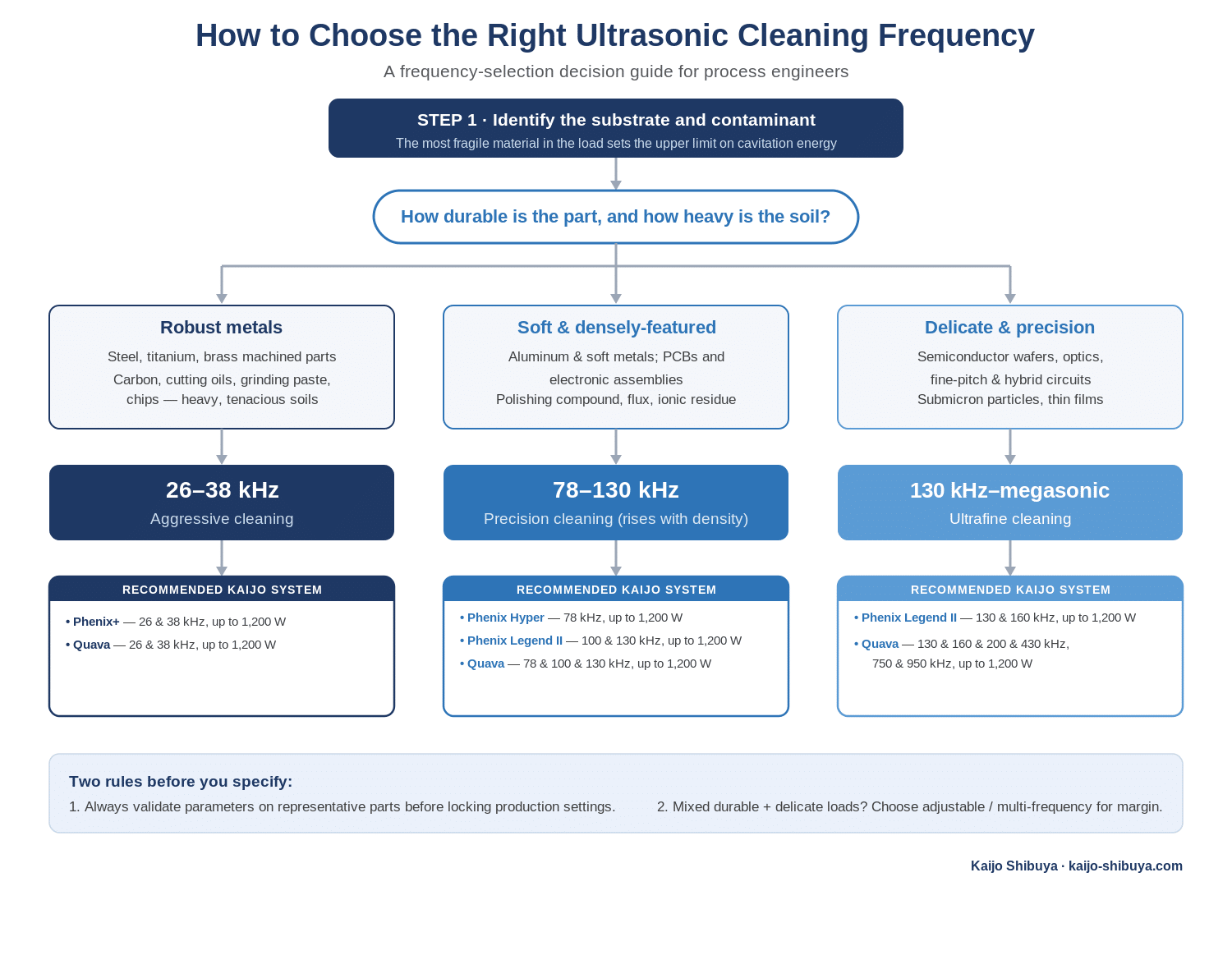
Kaijo’s differentiators map directly to this framework. With more than 70 years of ultrasonic engineering experience and a full frequency range from low- to high-frequency and megasonic. Custom system design and factory-direct technical support from Santa Clara, California — including sample cleaning trials and post-installation support.
Want help applying this framework to your parts? Kaijo’s engineers will review your substrate, contamination, and throughput and recommend frequency, power, and chemistry before you commit. Request an Application Consultation with Kaijo’s Experts.
6. Frequently Asked Questions
Q1: What is the best ultrasonic cleaning frequency for industrial applications?
There is no single best frequency. It depends on the substrate and contaminant. Heavy soils on robust metals clean well at 26–38 kHz, densely featured and softer parts suit 68–120 kHz, and delicate or precision components need 130 kHz and above. Matching frequency to the part is the goal.
Q2: Can using the wrong ultrasonic cleaning frequency damage my parts?
Yes. A frequency that is too low for a delicate part can pit or erode soft metals, thin films, and fragile features. A frequency that is too high for heavily soiled robust parts leaves residue behind. Both outcomes are avoidable with correct frequency selection and validation.
Q3: What frequency should be used for delicate industrial components?
Delicate components such as fine-pitch electronics, optics, wafers, and hybrid circuits generally require high frequencies of 100 kHz or higher, at which smaller, lower-energy bubbles clean without stressing the surface. The Phenix Legend II covers 100, 130, and 160 kHz for these applications.
Q4: How do I know if my current ultrasonic cleaning system is operating at the right frequency?
Watch for inconsistent results, residue in recesses, or surface damage on sensitive parts. These often signal a frequency mismatch, uneven energy distribution, or insufficient power density. A process review of your substrate and contaminant profile will confirm whether the frequency is appropriate.
Q5: What should I look for when evaluating ultrasonic cleaner manufacturers for a precision application?
Look for a full frequency range, genuine engineering support, the ability to validate parameters on your parts before purchase, custom configuration capability, and post-installation service. These distinguish established ultrasonic cleaner manufacturers from catalog suppliers.
Not Sure Which Frequency Is Right for Your Application?
Kaijo’s experts work directly with process engineers to match the right system to your application before you commit to a purchase. Review the full line of industrial ultrasonic cleaners and the ultrasonic cleaning technology behind them, then talk to an expert about your parts. Contact Kaijo to Request an Application Consultation.